Search This Blog

Tuesday, August 11, 2015

Italian Word of the Day

Day 20 - Bars:
 

Note:  Water can be purchased two ways in Europe.  With fizz and without fizz.  Carbonated water is very popular.  So make sure if you do not want fizz - you say no fizz.

Do you serve alcohol? 
Avete bevande alcoliche? (ah-VEH-teh beh-VAHN-deh ahl-KOH-lee-keh?)
 
A beer/two beers, please. 
Una birra/due birre, per favore. (OO-nah BEER-rah/ dweh BEER-reh, pehr fah-VOH-reh)
 
A glass of red/white wine, please. 
Un bicchiere di vino rosso/bianco, per favore. (oon beek-KYEH-reh dee VEE-noh ROHS-soh/ BYAHN-koh, pehr fah-VOH-reh)
 
I'd like a_______? 
Vorrei un_____? (vohr-RAY oon...?)
 
beer 
birra (BEER-rah)
 
wine 
vino (VEE-noh)
 
gin 
gin (jeen)
 
whiskey 
whisky (WEES-kee)
 
vodka 
vodka (VOHD-kah)
 
rum 
rum (rohm)
 
water 
acqua (AHK-kwah)
 
club soda 
club soda (kloob SOH-dah)
 
tonic water 
acqua tonica (AHK-kwah toh-NEE-kah)
 
orange juice 
succo di arancia (SOOK-koh dee ah-RAHN-chah)
 
Coke (soda) 
Coca Cola (KOH-kah KOH-lah)
 
A soda
Una soda. (OO-nah SOH-dah)
 
Do you have any bar snacks? 
Avete qualcosa da stuzzicare? (a-VE-te kwalcoza da STU-zee-ca-ray?)
 
One more, please. 
Un altro, per favore. (oon AHL-troh, pehr fah-VOH-reh)
 
Another round, please. 
Un altro giro, per favore. (oon AHL-troh JEE-roh, pehr fah-VOH-reh)
 
When is closing time? 
Qual è l'ora di chiusura? (kwah-LEH loh-RAH dee KYOO-zoo-rah?)

Friday, August 7, 2015

What NOT to Eat Overseas

Unpasteurized Dairy
Drinking unpasteurized milk, or eating unpasteurized dairy products like cheese or ice cream, is 150 times more likely to cause a foodborne illness than sticking to pasteurized dairy products, according to the FDA. Pasteurization (or the process of irradiation, in some countries) kills salmonella, E. coli, listeria, and other harmful bacteria that can be found in raw milk.
Related: 5 Foreign Foods That Can Kill You
Salad
Craving a crisp salad? Think twice before picking up your fork: The World Health Organization advises against green-leafed vegetables, since they can contain dangerous microorganisms that won't necessarily wash off with water. And in places where the water is of questionable quality, washing can actually compound the problem.
Fish and Shellfish
Bad news: Fish and shellfish may be delicious, but they can also be the source of some truly gnarly illnesses. For instance, anisakiasis is a raw-fish-based invasion of worms in the human gastrointestinal tract. Shellfish poisoning, meanwhile, can have paralytic, neurotoxic, or amnestic symptoms. Other types of seafood poisoning can cause vomiting, diarrhea, and even the sensation that your teeth are about to fall out.
Related: 9 Nasty Germ Zones to Avoid When Traveling
Buffet Foods
Buffets present a series of logistical food-safety challenges. Keeping foods from spoiling requires constant attention, but buffet food sits unattended for hours. People can cough or sneeze on the food, or touch it with their unwashed hands. Flies easily land—and poop—on food exposed to the air. And then there's the temperature problem: Hot foods need to stay piping hot, and cold foods must remain refrigerator-cold to ward off bacteria growth. With so many elements working against your intestinal health, it's better to steer clear of buffets anywhere you're not 100 percent confident of food handling and safety techniques.
Raw Eggs
Want to avoid foodborne illness in another country? Then skip runny eggs, novelty cocktails, homemade mayonnaise, and other products that rely on raw or undercooked eggs. If you're preparing local eggs yourself, don't wash or soak them, either—according to the University of Michigan, doing so can drive bacteria from the shell into the interior of the egg.
Related: 11 Secret Natural Cures for Travel Ailments
Certain Fruits
Fruit has its own special place in the traveler food safety adage, "Boil it, cook it, peel it, or forget it!" Avoid fruits that don't come with a built-in thick peel. The good news is that fruits with a thick peel are protected from tainted water and soil, and are considered safe to eat just about everywhere. Bananas, mangoes, pineapple, and papayas are among the delicious fruit protected by their own tough peels. For maximum safety, peel the fruit yourself, and make sure any cutting implements are clean and dry when you start.
Undercooked Meat
Undercooked meat often tastes really good. But you still might consider avoiding it, at least when you're not 100 percent confident about its path from farm to table. Raw meat presents two layers of potential contamination. The exterior surface is basically a canvas for enteric pathogens, but these are easily killed off by cooking. However, there's also the chance of parasitic pathogens in the muscle tissue, and that's why food safety experts make such a big deal about cooking meat to an internal temperature of 160 degrees Fahrenheit.
Related: 7 Risky Foods to Avoid While Traveling
Bush Meat
Even the most adventurous carnivores should avoid eating monkey, bats, and wild game if gastrointestinal health is a priority. The CDC advises against eating "bush meat," the flesh of undomesticated animals. Raw bush meat has been suspected of creating a transmission bridge for Ebola and other animal-to-human viruses. Cooked, the meat can still be problematic, especially for travelers whose bodies are unused to local bacteria. And conservationists suggest avoiding bush meat since it could come from endangered or threatened species.
Popsicles
At first glance, a fun frozen treat like popsicles may seem like the most innocuous item on this list. But poor-quality water, fruit without thick peels, and unpasteurized dairy are often the main ingredients, making popsicles a triple threat in places where food safety may be an issue. If you're in a place where you're avoiding the water, do yourself a flavor and put that ice pop down, too.

Thursday, August 6, 2015

Eating Overseas

Today I want to talk about eating overseas.  The good news is there is always a McDonalds close at hand.  The bad news is something we might expect will taste like it does here at home - does not.  I remember the first time I ordered ketchup in northern Australia.  It did not taste like ketchup.  I ruined my scrambled eggs. 

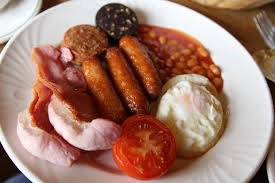
Breakfast for instance in Ireland will say bacon.  However their bacon is nothing like ours.  you will not get a nice crisp strip of bacon.  You will get something more like ham.  They also serve a fried tomato and beans with their traditional breakfast.  The beans taste like canned pork and beans.  Below you can see a typical breakfast.  The next paragraph will explain.

In Ireland, as elsewhere, the exact constituents of a full breakfast vary, depending on geographical area, personal taste and cultural affiliation. Traditionally, the most common ingredients are bacon rashers, pork sausages, fried eggs, white pudding, black pudding, toast and fried tomato.[13] Sauteed field mushrooms are also sometimes included,[14] as well as baked beans, hash browns, liver, and brown soda bread.[15][16][17] Fried potato farl, boxty or toast is sometimes served as an alternative to brown soda bread.
The "breakfast roll",[18] consisting of elements of the full breakfast served in a French roll, has become popular due to the fact it can be easily eaten on the way to school or work, similar to the breakfast burrito in the United States.[18] The breakfast roll is available from many petrol stations and convenience stores throughout Ireland.[18] In 2006 Irish comedian Pat Shortt released a song called "Jumbo Breakfast Roll".


It is not abnormal for me to make sure I take a small bottle of ketchup with me overseas.  How can someone enjoy fries (I mean chips) without proper ketchup?
 
In Europe they do not call French Fries fries.  Fries are called chips and chips are called crisps.  Hence the menu item fish and chips.  I find it hard to find BBQ chips - instead they have paprika crisps.  Another example is a cookie is called a biscuit and a biscuit is called a scone.
 
You will find this throughout the language and culture.  A few more are:
 
sneakers = runners or trainers
sweater = jumper (same in Australia)
fast food place that sales fries = chipper
sidewalk = footpath or pavement
car trunk = boot
car hood = bonnet
windshield = windscreen
attractive person = a ride
trash can = bin
suspenders = braces
parking lot = car park
drug store = chemist
stove = cooker
expensive = dear
cigarette = fag
overpass = flyover
soccer = football ** THIS IS VERY IMPORTANT TO THEM
satisfied = happy as Larry
rent = hire
underpants = knickers
truck = lorry
vacation = holiday
elevator = lift
bathroom = loo / toilet
ground beef = mince
cell phone = mobile
diapers = nappies
pass traffic = overtake
gas = petro
drunk = pissed
mail = post
call someone = ring
high school = secondary school
outlet = socket
weight = stones (14 pounds to a stone)
faucet = tap
grocery cart = trolley
 
In closing just remember - if there is something you cannot live without maybe take it with you.  You will definitely find things you like over there that you cannot get here.  However Amazon it taking care of that.  I love the tea in Ireland.  Oh - and the chocolate because there is nothing like a Cadbury. 
 
Tomorrow we will talk about the foods you should never eat overseas.


Wednesday, August 5, 2015

Italian Word of the Day

Day 19 - eating

A table for one person/two people, please.
Un tavolo per uno/due, per favore. (oon tah-VOH-loh pehr OO-noh/ dweh, pehr fah-VOH-reh)
 
Can I look at the menu, please? 
Posso vedere il menu, per favore? (POHS-soh veh-DEH-reh eel meh-NOO, pehr fah-VOH-reh?)
 
fixed-price meal 
pranzo a prezzo fisso (PRAH-tsoh ah PREHD-zoh FEES-soh)
 
à la carte 
à la carte (AH lah KAHR-tah)
 
breakfast 
la prima colazione (lah PREE-mah koh-lah-TSYOH-neh)
 
lunch 
il pranzo (eel PRAHN-dzoh)
 
 supper 
la cena (lah CHEH-nah)
 
I would like _____. 
Vorrei _____. (vohr-RAY)
 
chicken 
il pollo (eel POHL-loh)
 
beef 
il manzo (eel MAHN-dzoh)
 
fish 
il pesce (eel PEH-sheh)
 
ham 
il prosciutto (eel proh-SHOOT-toh)
 
sausage 
salsiccia (sahl-SEET-chah)
 
cheese 
formaggio (fohr-MAHD-joh)
 
eggs 
uova (WOH-vah)
 
salad 
insalata (een-sah-LAH-tah)
 
(fresh) vegetables 
verdure fresche (vehr-DOO-reh FREHS-keh)
 
(fresh) fruit 
frutta fresca (FROOT-tah FREHS-kah)
 
bread 
pane (PAH-neh)
 
 rice 
riso (REE-zoh)
 
coffee 
caffè (kahf-FEH)
 
tea (drink
tè (TEH)
 
juice 
succo (SOOK-koh)
 
the water 
l'acqua (LAHK-kwah)
 
the bubbly water 
l'acqua frizzante (LAHK-kwah free-DZAHN-teh)
 
 beer 
birra (beer-RAH)
 
 red/white wine 
vino rosso/bianco (VEE-noh ROHS-soh/ BYAHN-koh)
 
May I have some _____? 
Posso aver del _____? (POHS-soh AH-vehr dehl...?)
or Posso avere un po' di ____? (POHS-soh ah-VEH-reh oon POH dee...?)
 
 salt 
sale (SAH-leh)
 
 black pepper 
pepe (PEH-peh)
 
Excuse me, waiter? (getting attention of server) 
Scusi, cameriere?(m)/cameriera?(f) (SKOO-zee, kah-meh-RYEH-reh?/ kah-meh-RYEH-rah?)
 
I'm finished. 
Ho finito. (oh fee-NEE-toh)
 
It was delicious. 
È squisito. (EH skwee-ZEE-toh)
 
The check, please. 
Il conto, per favore. (eel KOHN-toh, pehr fah-VOH-reh)


Tuesday, August 4, 2015

San Marco Square Venice Italy


Piazza San Marco, or Saint Mark's Square, is the largest and most important square in Venice. Being the widest swath of flat, open land in a waterborne city, Piazza San Marco has long been an important meeting place for the citizens of Venice and the design showcase for Venice's aristocracy. It is most impressive from its sea approach, a legacy from the centuries that Venice was a powerful maritime republic.

Piazza San Marco has famously been called "the drawing room of Europe," a quote attributed to Napoleon. The square is named after the unusual and stunning Basilica San Marco that sits on the east end of the square. The slender Campanile di San Marco, the basilica's bell tower, is one of the square's most recognizable landmarks.
Adjacent to Saint Mark's Basilica is the Doges' Palace (Palazzo Ducale), the erstwhile headquarters of the Doges, the rulers of Venice. The paved area that extends from the Piazza San Marco and forms a large "L" shape around the the Doges Palace is known as the Piazzetta (little square) and the Molo (jetty). This area is characterized by the two tall columns along the waterfront which represent Venice's two patron saints. The Column of San Marco is topped with a winged lion while the Column of San Teodoro holds up a statue of Saint Theodore. (see photo)
Saint Mark's Square is bordered on its other three sides by the Procuratie Vecchie and Procuratie Nuove, built, respectively, in the 12th and 16th centuries.

These connected buildings once housed the apartments and offices of the procurators of Venice, government officials who oversaw the administration of the Venetian Republic. Today, the Procuratie Nuove houses the Museo Correr, while famous cafés, such as the Gran Caffè Quadri and Caffe' Lavena, spill out from the Procuraties' arcaded ground floors.
Save time by buying a San Marco Square Pass from Select Italy that includes admission to the 4 major sites on Piazza San Marco plus one additional museum. Cards are valid for three months from the pick-up date.

Monday, August 3, 2015

More overseas travel tips:

Here are some more travel tips for traveling overseas.  If there are repeats from earlier posts I apologize.

The six-month passport rule. The expiration date on your passport is actually a bit deceiving. The U.S. lets you use your passport up to the date inside the cover. However, several countries will deny travelers entry if the passport expires in less than six months. Why? If for some unexpected reason you get stuck overseas longer than planned, that country wants to ensure that you have a valid passport to eventually travel back to the United States.

Foreign airline sites. If you are on a tight budget and don't have to book your ticket before you go —look at overseas airlines’ sites in their home countries. The airline’s U.S. site wanted twice the price of the Italian site. Google will translate for you.

Data roaming/ cell service. Set up your cell phone to avoid international data roaming.  The biggest costs can come from transmitting data overseas.  Do this when you are on the airplane and your phone is in airplane mode.  I racked up a really large cell phone bill using maps and did not realize the amount of data I was using.   Quite a few places offer free Wi-Fi so you can utilize your Wi-Fi for email and surfing.  If you want to use your cell phone overseas remember to sign up for an international plan before you go.  It is still expensive to call but in the case of an emergency you will be glad you did.

Unwanted local currency. I figure out on my last night how much cash I will need and then set aside the leftover money. At checkout the next morning, I take that cash and ask the hotel to apply it to my bill and then pay the remaining balance with my no-foreign-transaction-fee credit card.

Be careful drinking bottled water, soda, mixed dinks, etc with ice cubes.  The ice cubes can be contaminated or contain things your body is not use to and cause sickness.

Take a photo of your luggage.  Unfortunately luggage can be lost.  It always helps explaining what it looks like to the airline if you have a picture. 

Notify the US State Department.  A lot of people remember to notify their credit cards companies - but it is also good practice to notify the US State Department. 

Jewelry.  Don't bring your expensive jewelry.  It will just be an advertisement for trouble.  Bring your favorite inexpensive baubles. 

Clothing.  If you are traveling in the summer and plan to visit churches or Mosques - bring appropriate attire.  You cannot tour San Marco Basilica with your shoulders showing.  They usually won't let women wear shorts either. 

Copies of documents.  I want to repeat this one again because it is so important.  Make copies of your passport so you have them with you and leave one at home with a family member or friend.  Make sure someone at home also has your itinerary. 

Italian Word of the Day

Day 18 - Colors

black 
nero (NEH-roh
 
white 
bianco (BYAHN-koh)
 
gray 
grigio (GREE-joh)
 
red 
rosso (ROHS-soh)
 
blue 
blu (bloo)
 
yellow 
giallo (JAHL-loh)
 
green 
verde (VEHR-deh)
 
orange 
arancione (ah-rahn-CHOH-neh)
 
purple 
viola (VYOH-lah)
 
brown 
marrone (mahr-ROH-neh)